What is a lead-acid battery
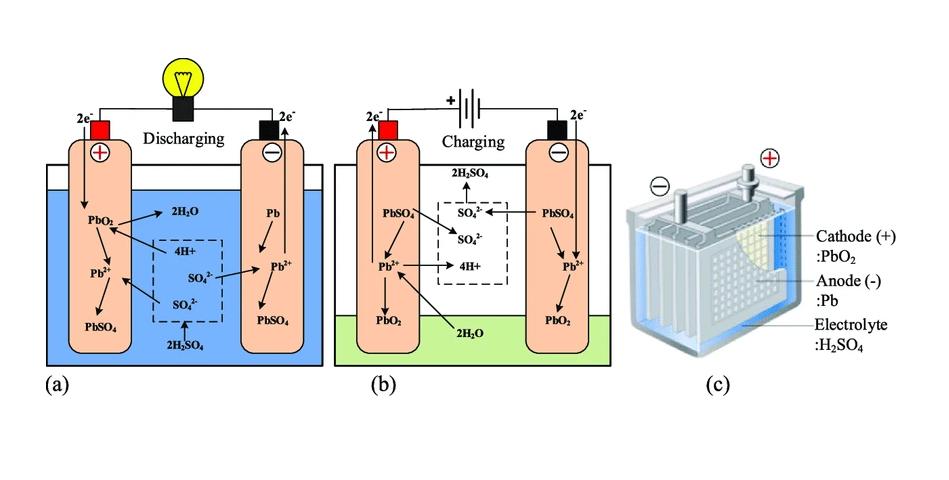
A lead-acid battery (VRLA) is a battery whose electrodes are mainly composed of lead and its oxides and whose electrolyte is a sulfuric acid solution. In the discharge, the main component of the positive electrode of the lead-acid battery is lead dioxide, and the main component of the negative electrode is lead; in the charging, the main components of the positive and negative electrodes are lead sulfate. The discharge diagram is as follows:
Advantages:
- Good safety performance. Lead-acid batteries are easy to maintain and can continue to be used after being damaged with a little repair.
- Lower price. The price of lead-acid batteries is about 1/3 of that of lithium batteries, which shows that they are cheap.
- Recyclable and reversible repair. Lead-acid batteries are highly recyclable. After the lead-acid batteries are worn out, they can go to the electric vehicle store to replace the old batteries with new batteries. After making up the difference, they can replace a new set of batteries, which can minimize the loss, which is a great benefit for users. The lead in the battery can also be recycled to reduce environmental pollution.
Disadvantages:
Heavy weight, limited battery capacity, and short service life. The service life of a lead-acid battery is generally about two years within 400 deep charges and deep discharges.
What is a lithium battery?
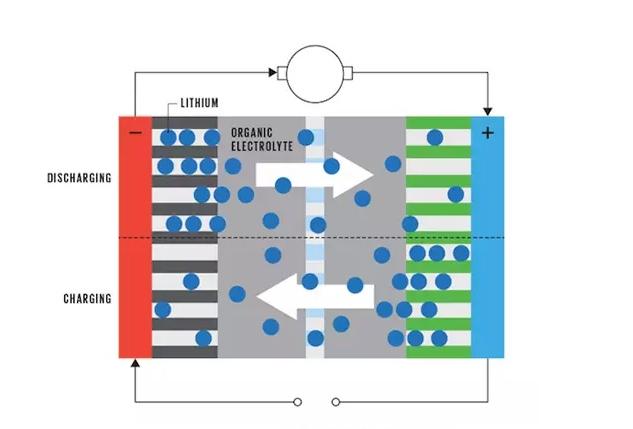
A lithium battery is a battery that uses metallic lithium or lithium alloy as the positive electrode material and a non-aqueous electrolyte solution. Because the chemical properties of metallic lithium are very active, the processing, storage and use of metallic lithium have very high environmental requirements. Lithium batteries can be roughly divided into two categories: lithium metal batteries and lithium-ion batteries.
Advantages:
- Light weight and small size. The volume of a lithium battery is 2/3 of that of a lead-acid battery, and its weight is about 1/3 of that of a lead-acid battery. The capacity of a lithium battery of the same volume is higher than that of a lead-acid battery. The reduction in weight makes electric vehicles lighter, while the endurance increases by about 10%.
- Long life. The average life of a lithium battery is about 4 years, about 1.5 times that of a lead-acid battery. It can be charged and discharged more than 500 times. The battery has no memory and is highly shock-resistant.
- Good overcharge resistance and charge and discharge resistance. At room temperature, lithium batteries can be charged continuously for 48 hours without battery expansion, leakage, rupture and other accidents, and the capacity remains above 95%. Moreover, they can be charged and discharged quickly under a dedicated charger.
Disadvantages:
The production cost of lithium batteries is high, and the production equipment is expensive. Labor costs account for about 40% of the production cost, and the price is about three times that of lead-acid batteries (however, thanks to the progress of the industry and excellent cost control, the price of mindtech's lithium battery energy storage systems can be the same as that of lead-acid batteries).
The detailed comparison is as follows:
- Weight energy density
At present, the energy density of lithium batteries is generally 200-260wh/g, and the energy density of lead-acid batteries is generally 50-70wh/g. Then the weight energy density of lithium batteries is 3-5 times that of lead-acid batteries, that is, under the same capacity conditions, lead-acid batteries are 3-5 times that of lithium batteries. Therefore, lithium batteries have an absolute advantage in the light weighting of energy storage devices.
- Volume energy density
The volume capacity density of lithium batteries is usually about 1.5 times that of lead-acid batteries. Therefore, under the condition of the same capacity, the volume of lithium batteries is about 30% smaller than that of batteries.
- Service cycle
At present, the more popular material systems are ternary and iron lithium. The number of cycles of ternary power lithium batteries is usually more than 1,000 times, the number of cycles of lithium iron phosphate batteries is more than 2,000 times, and the number of cycles of storage batteries is usually only about 300~350 times. Therefore, the service life of lithium batteries is about 3-6 times that of lead-acid batteries.
- Applicability
Since the safety of lithium batteries is slightly worse than that of lead-acid batteries, various safety precautions need to be taken during use, such as preventing damage to lithium batteries due to external forces or accidents, because it may cause fire or explosion; At present, the temperature applicability of lithium batteries is also very good, so in other aspects of adaptability, lithium batteries are not inferior to lead-acid batteries.
- Scenarios of use
Lead-acid batteries: car starters, electric vehicle batteries.
Lithium battery: mobile phones, computers, power tools, UPS power supplies, etc., also used in electric vehicle batteries.
- Internal materials and discharge characteristics
Lead-acid battery: the positive and negative electrodes are lead oxide and metallic lead, and the electrolyte is concentrated sulfuric acid.
Lithium battery: the positive and negative electrodes are lithium cobalt oxide/lithium iron phosphate/lithium manganese oxide, graphite and organic electrolyte.
This causes the two batteries to have completely different discharge characteristics. For the same fully charged lithium battery and lead-acid battery, at the same temperature and different discharge current rates, the discharge output characteristics of the lithium battery are very stable, while the discharge output characteristics of the lead-acid battery are very different, which will cause power instability.
- Safety
The safety of lead-acid batteries is relatively high, and it is not easy to explode and other dangerous situations under normal use. Lithium batteries may have the risk of fire and explosion when they are improperly used or damaged, but with the advancement of technology, their safety is constantly improving.
- Environmental protection
Lithium iron phosphate batteries do not contain any heavy metals and rare metals, are non-toxic, and are pollution-free in production and use. They comply with European ROHS regulations and are green batteries. However, there is a large amount of lead in lead-acid batteries. If not handled properly, it will still cause secondary pollution to the environment.
- Operating temperature range
The operating temperature range of lithium batteries is -20-60℃, and the operating temperature range of lead-acid batteries is -30-60℃. Lead-acid batteries have a wider operating temperature, so under certain conditions, lithium battery systems will add additional temperature control components to achieve a lower operating temperature range (but this will consume its internal power, resulting in a decrease in energy storage effect).
The Mindtech B-50, B-60, B-100, and B-200 batteries use the latest lithium battery technology, with an ultra-long 5-year lifespan and high energy density at the same price as lead-acid batteries.


